
Bending and stamping
for sheet metal components
Materials
Steel, stainless steel, aluminium, brass
Volume
Prototype → series production
Bending and stamping as one link in a complete supply chain.
Most suppliers sell sheet metal work as a stand-alone fabrication service. We don't. At Pamatek, bending and stamping sit inside an integrated flow that runs from material selection through forming and welding to surface treatment, assembly and logistics — managed by one team, documented through one QA chain, delivered on one purchase order.
That's the difference between buying a sheet metal part and buying a finished component ready for your production line — with the forming sequence engineered alongside the geometry, not negotiated after the drawing is locked. And in many cases, switching from laser cutting to progressive stamping at the right volume turns a per-part cost into a per-batch cost — often the single largest saving in the entire sheet metal supply chain.

Press brake bending
CNC press brake forming for precision sheet metal components — material thicknesses from 0.5 to 8 mm in steel, stainless and aluminium. Press brake bending forms sheet metal into precision components through controlled tool pressure against a die — single bends, multiple sequenced bends and complex geometries with tight angular tolerances. We work with material thicknesses from 0.5 to 8 mm across steel, stainless steel, aluminium and brass, with bend angles verified through in-process measurement and documented per batch. Tool selection and bend sequencing are part of the engineering review, not assumed from the drawing. The wrong tool order produces parts that are technically within tolerance but practically unfit for assembly — we eliminate that risk before the first bend is made. Typical applications include enclosure panels, structural brackets, mounting plates and chassis components for the appliance, tech and audio industries.
.jpeg)
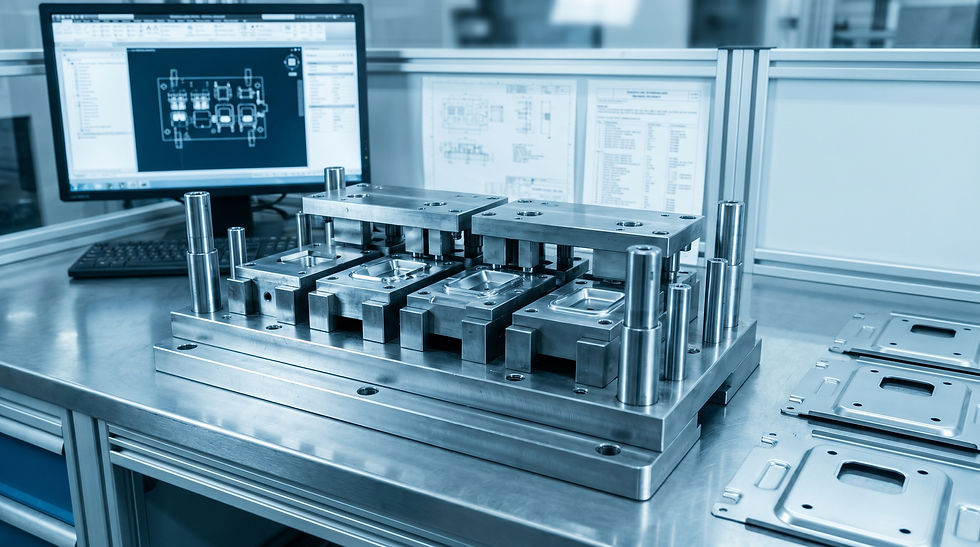
Stamping and progressive forming
Single-station and progressive die stamping for medium to high volume sheet metal components — often replacing laser cutting at scale, where tooling investment pays back several times over in reduced per-part cost and faster throughput.
.jpeg)
Cutting, welding and fabrication
Laser cutting, punching, welding and integrated fabrication — sheet metal arrives assembly-ready rather than as flat blanks. A bent or stamped part is rarely the deliverable. It needs to be laser-cut or punched from sheet, deburred, welded into sub-assemblies, surface-treated, and often combined with other components before it reaches the production line. We integrate these operations into the same job, scheduled and documented as one flow rather than four separate sub-contracts. Cutting, welding, surface treatment and assembly run on the same QA chain as the forming itself, with material traceability preserved end to end. For you, that means one purchase order, one point of contact and one set of inspection records — instead of coordinating multiple suppliers and absorbing the lead time between them.
Engineered before
it's bent.
Design for manufacturing
Most sheet metal designs come in with the geometry locked but the forming sequence assumed. Too often the bend order, the tool clearances and the corner reliefs haven't been thought through — and the part either can't be formed in the available tooling, or fails inspection because the assumptions didn't survive the first bend.
We bring forming engineering into the conversation early. Before the drawing is finalised, our engineers review the bend sequence, tool reach, internal radii, corner reliefs and material grain direction — the decisions that determine whether the part forms cleanly and whether it is economical to produce at volume.
The earlier we're involved, the more we can remove from your cost and rework. A 30-minute DFM session often saves weeks of iteration later.
Explore other
manufacturing methods.
CNC is rarely a standalone process. We combine it with casting, forming and finishing to deliver complete components — often in a single purchase order.
HQ
Pamatek A/S
DK29841446
Bækgårdsvej 72
4140 Borup
Tel.: +45 70 233 637
© 2026 by Klamer Dueholm Fractionals.