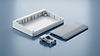
Plastic moulding
for engineered components
Tolerances
Standards ISO 20457 / DIN 16742
Materials
ABS, PC, PA, POM, PP, engineering plastics
Volume
Prototype → series production
.jpeg)
Injection moulding
recision injection moulding for thermoplastic components — shot weights from 5 g to 1500 g across engineering and commodity grades. Injection moulding shapes molten thermoplastic into precision components through controlled pressure into a closed tool, producing parts with consistent geometry, surface finish and mechanical properties at volume. We work with shot weights from 5 grams to 1500 grams across engineering plastics like ABS, PC, PA and POM as well as commodity grades like PP and PE, with cycle times and tool design matched to the production volume. Material selection is part of the engineering review, not assumed from the drawing. The wrong polymer grade produces parts that meet the geometric specification but fail the application — wrong stiffness, wrong impact resistance, wrong dimensional stability. We close that gap before the tool is cut. Typical applications include enclosure housings, structural components, functional parts and consumer-facing components for the appliance, tech and audio industries.

Tool design and qualification
Mould tool development from concept and DFM review through sampling and qualification to approved series production. A precision injection tool starts with a conversation about geometry, tolerances, expected volume and downstream operations. Our engineers review the part for moulding feasibility — wall thickness uniformity, draft angles, gate location, ejection strategy, cooling layout — the parameters that determine whether the tool runs cleanly at cycle or fights the process on every shot. Sampling is done before the tool is released for series. Dimensional verification, surface inspection, material qualification and cycle stability are documented up front, so the first production batch behaves like every batch after it. The tool remains tied to your part number, which protects continuity across re-orders and forecast volumes.
.jpeg)
Finishing and assembly
Trimming, machining, decoration, ultrasonic welding and assembly integrated into the same delivery — part arrives assembly-ready. A moulded part is rarely the deliverable. It needs to be deflashed and trimmed, sometimes machined for secondary features, decorated with pad printing, hot stamping or in-mould labelling, ultrasonically welded to mating components, and often combined with other parts before it reaches the production line. We integrate these operations into the same job, scheduled and documented as one flow rather than four separate sub-contracts. Trimming, decoration, welding and assembly run on the same QA chain as the moulding itself, with material traceability preserved end to end. For you, that means one purchase order, one point of contact and one set of inspection records — instead of coordinating multiple suppliers and absorbing the lead time between them.
HQ
Pamatek A/S
DK29841446
Bækgårdsvej 72
4140 Borup
Tel.: +45 70 233 637
© 2026 by Klamer Dueholm Fractionals.
Explore other
manufacturing methods.
CNC is rarely a standalone process. We combine it with casting, forming and finishing to deliver complete components — often in a single purchase order.
Plastic moulding as one link in a complete supply chain.
Most suppliers sell plastic moulding as a stand-alone production service. We don't. At Pamatek, plastic moulding sits inside an integrated flow that runs from material selection through tooling and moulding to surface treatment, assembly and logistics — managed by one team, documented through one QA chain, delivered on one purchase order.
That's the difference between buying a moulded part and buying a finished component ready for your production line — with the material grade, gating strategy and downstream operations engineered together rather than negotiated separately.

Engineered before
it's moulded.
Design for manufacturing
Most plastic part designs come in with the geometry locked but the moulding strategy assumed. Too often the wall thickness logic, draft angles, gate location and ejection strategy haven't been thought through — and the part either can't be moulded reliably, or arrives with sink marks, weld lines and warpage that no amount of process tuning can eliminate.
We bring tooling engineering into the conversation early. Before the steel is cut, our engineers review the wall thickness uniformity, draft angles, gate location, runner layout and cooling strategy — the decisions that determine whether the tool runs cleanly at cycle and whether the part is economical to produce at volume.
The earlier we're involved, the more we can remove from your cost and rework. A 30-minute DFM session often saves weeks of iteration later.